
Cost
Concrete Slab Cost in Kenosha County
One word covers everything from a shed pad to a house foundation. Sort them by what has to stand on top and the pricing stops looking arbitrary.
Ask three contractors what a slab costs and you may get three honest answers that are nowhere near each other. That is not evasion. It is that "slab" describes a shape rather than a job, and the price is set by something the word leaves out entirely: what the concrete has to hold up.
The published numbers, sorted by what sits on them
HomeGuide prices slab work between $6 and $12 a square foot fitted, which lands a 900 square foot pour at $5,400 to $10,800. More usefully, they also separate it out by what the slab is for:
- Shed foundation, 100 to 400 sq ft - $600 to $4,800
- Patio, 200 to 400 sq ft - $1,000 to $6,000
- RV pad, 200 to 700 sq ft - $1,200 to $8,400
- Garage floor, 400 to 576 sq ft - $2,400 to $6,900
- Mobile home slab, 600 to 1,600 sq ft - $3,600 to $19,200
- Foundation, 800 to 2,400 sq ft - $4,000 to $33,600
Their data, nationally gathered. Notice the shape of that list: it climbs with load, not merely with area. A foundation runs to $33,600 while a shed pad of similar construction starts at $600, and the gap is mostly reinforcement, depth and footings.
Rung one: the slab that carries nothing
A shed pad, a grill pad, a place for the bins. A patio in Kenosha County sits on this rung as well, furniture being the heaviest thing it ever carries. Four inches of concrete over four inches of compacted stone, no reinforcement required, no footings, no inspector. It floats on the ground and moves with it, and because nothing is fixed to it that movement is harmless.
This is the cheapest concrete you can buy and the least likely to disappoint you, provided the stone underneath is done properly.
Rung two: the slab that carries a car
Garage floors and parking pads. Still slab on grade, still no frost footings if the walls are carried elsewhere, but the specification tightens in two ways that matter here.
First, reinforcement becomes worth having, because a point load rolling across a slab is a different demand than a static one. Second and more importantly, a vehicle floor in this county gets salt delivered to it every winter, driven in on the tyres and dripped off overnight into a warm garage. That is the single harshest thing residential concrete faces around here, and it makes the air content specification a genuine question rather than a formality.
Rung three: the slab that carries something heavy
An RV pad, a shop floor, a slab that will see a loaded trailer or a truck. Here you are into five or six inches, a considered reinforcement layout, and real attention to the sub-base, since concentrated weight punishes soft spots that a car would never find.
The published RV pad range reaching $8,400 for what can be a fairly modest footprint is telling you exactly this: the money is going downward into the ground, not outward into square feet.
Rung four: the slab that carries a building
An addition, a garage whose walls sit on the perimeter, a house. Code enters the picture here. Footings in this state go down 48 inches, and deeper again on any site where frost gets past that line, a requirement written specifically for footings and foundations beneath a structure.
That single requirement is most of why the foundation row in the table above reaches $33,600. You are no longer buying a flat surface. You are buying excavation well below the frost line, formed footings, and an inspection regime attached to them.
Get a real number for your slab
Four quick questions and a local concrete contractor will be in touch to set up a free on-site estimate. No obligation, and "just pricing it out" is a perfectly good answer.
The mistake this ordering is designed to prevent
Homeowners get quoted for the wrong rung all the time, in both directions.
Upward, it looks like frost piers priced into a shed pad. If nothing is bearing on the slab, those piers are carrying nothing, and the honest answer to "what are they for" is usually that the bid was copied from a different kind of job.
Downward is the expensive one. A slab poured as flatwork that later has walls put on it has no footings under those walls, and in a frost climate that is a problem which announces itself in a few winters rather than immediately. If there is any prospect of the structure going up later, say so before the concrete is ordered, not after.
Five questions that make slab bids comparable
- Which of these is this quote priced as, and is anything going to bear on the slab?
- What depth of concrete, and is there reinforcement in it?
- How much stone underneath, and is it compacted in more than one pass?
- What air content is being ordered, given this surface will meet salt?
- If footings are in the price, what load are they carrying?
What the ground contributes
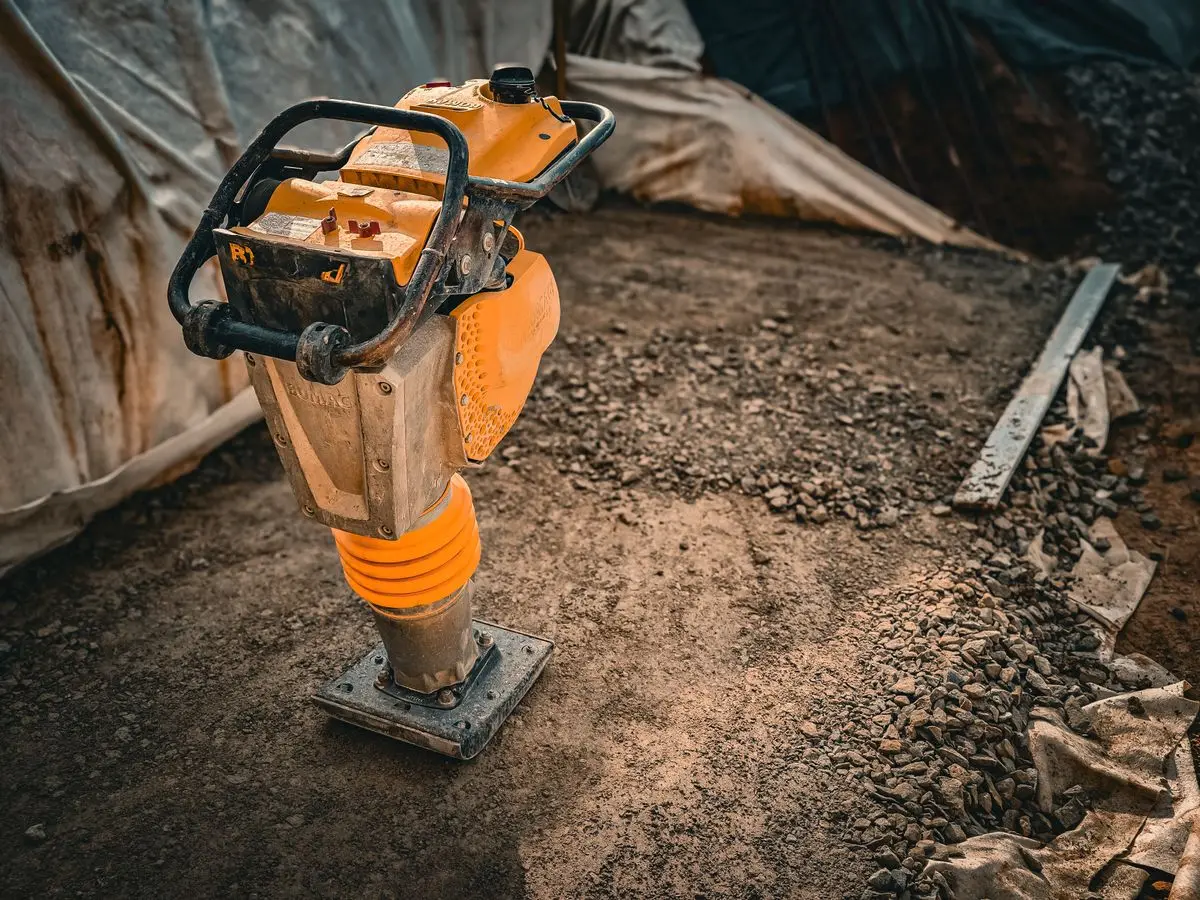
Whatever rung you are on, the sub-base decides more than the concrete does. Every failed slab we get asked to look at in this part of Wisconsin failed from below: soft material left in place, compaction done in one go rather than in layers, or water with nowhere to drain.
Concrete is not the expensive part of concrete work. The preparation is, and it is the first thing trimmed when a bid needs to look competitive. That holds whatever goes on top, which is why the concrete or asphalt question is settled by the ground far more often than by the material.
Keeping it in one piece
Keep vehicles off for a week. Then run the first winter without chemicals of any kind. Concrete that new is still carrying water it has not released, and it has not yet earned the strength to be frozen in that state.
Ignore the standard suggestion to move to a milder chloride. In Oregon DOT's comparison of deicers against compressive strength loss, magnesium chloride finished worst of the products tested, which is awkward given how often it is named as the safe one. Both magnesium and calcium chloride sit on the Wisconsin ready mixed association's avoid list. Grit handles traction and costs the slab nothing at all.
Sources
- HomeGuide - slab cost per square foot and by project purpose. Figures verified 2026-08-18.
- Wis. Admin. Code SPS 321.16 - footing depth for structures.
- Wisconsin Ready Mixed Concrete Association - curing and deicer guidance.
- Oregon DOT SPR 742 - chloride deicers and compressive strength.